


The Q4 Playbook Just Changed: 4 Shifts to Act On B…
The major platforms rolled out some of their biggest changes of the year right before the busiest selling season. Here’s what changed and what we’d…



Think about the last time you wanted to find a new restaurant, a resort to book for the weekend, or a local service you had not used before. Did you open Google and type in a search query? Or did you scroll through Instagram, watch a few TikTok videos, or ask your network on Facebook?
If you chose social media, you are not alone. And if your digital marketing strategy still treats Google as the only search channel that matters, you are quietly becoming invisible to a growing portion of your potential customers.
Social search, the act of using platforms like TikTok, Instagram, YouTube, and Facebook to discover products, places, and services, is no longer a niche behaviour. It is a mainstream shift that is reshaping how consumers find, evaluate, and choose brands. It is also rewriting the rules of search engine optimization (SEO) itself, with direct implications for every business that relies on being found online.
This article breaks down what is happening, what the data tells us, and how to use social media for SEO, starting today.

The numbers are striking. A 2025 survey found that 49% of US consumers now use TikTok as a search tool, up from 41% just one year earlier. Among Gen Z, the figure climbs to 64% who have used TikTok specifically for online searches. Nearly 1 in 3 consumers now skip Google entirely for some types of searches, going directly to social platforms instead, and for Gen Z, that number rises to more than half.
This is not a prediction about where things are heading. This is already happening.
What is driving this shift? Social platforms offer something traditional search engines have always struggled to provide: authenticity and visual context. When a potential guest is considering booking a cabin for the weekend, they are not just looking for a website with the right keywords. They want to see the lake. They want to watch a short video of someone lighting the fire pit. They want to feel the experience before they commit. Social media delivers that in a way no text-based search result can match.
TikTok’s search volume alone grew over 40% year-over-year, with billions of searches occurring on the platform daily. Instagram, YouTube, Pinterest, and Reddit have all seen similar upticks in search activity. The platforms users once used purely for entertainment have become their default discovery engines.
Social media has replaced search engines for Gen Z. More than half start their discovery journey on social platforms, not Google.
Search engine optimization is the practice of optimizing your website and content so that Google and other search engines rank it highly for relevant queries. It has long been the backbone of SEO marketing: keyword research, website SEO, blog SEO, backlinks, and technical fixes, all aimed at improving your SEO ranking on Google.
Social media SEO applies the same logic to social platforms: optimizing your content, profiles, captions, and hashtags so that people can find you when they search within Instagram, TikTok, YouTube, or Facebook. Keyword optimization is no longer just for your website, it now belongs in your bios, captions, and video hooks too.
SEO and social media are no longer separate disciplines. Within modern digital marketing, they are converging on a single question: when someone is looking for what you offer, can they find you?
Instagram’s search function processes millions of queries every day. Users search by keyword, location, hashtag, and account name, and the results they see are influenced by how well a business’s profile and content are optimized. An Instagram Reel with a well-crafted caption, the right hashtags, and a clear geo-tag is searchable content, not just entertainment.
TikTok has explicitly positioned itself as a discovery platform. Its algorithm surfaces content based on relevance and engagement, meaning a well-made video about your product, destination, or service can reach thousands of users who have never heard of you, purely because they searched a related term.
YouTube, owned by Google, has always been a search engine for video. It is the second-largest search engine in the world by volume, handling over 3 billion searches per month. Businesses that create informative or engaging video content on YouTube capture search intent in a format that increasingly outcompetes traditional web pages, one of the clearest examples of search engine optimization strategies expanding beyond the website.
Social search is not just about discoverability. It drives significantly higher engagement than traditional search results. TikTok’s average engagement rate sits at approximately 3.7 – 4%, compared to well under 1% for most web pages. Instagram, even at a platform-wide average of 0.5 – 1.5%, dramatically outperforms the click-through rates typical of search ads.
For context: when Vigilante Marketing manages a client’s Instagram presence with a disciplined content strategy, we routinely achieve engagement rates of 2.5 – 3.5%, two to four times the industry average for hospitality brands, and well above what most social media marketing companies deliver. That is not just a vanity metric. Higher engagement means more people are genuinely interacting with your brand, which translates directly into brand recall, trust, and eventually, bookings or purchases.

Here is the part that should make every business owner pay attention: Google is not sitting still while social search grows. It is actively incorporating social content into its own results, which means Google SEO now rewards brands with a strong social presence.
Since 2023, Google has indexed TikTok videos in search results. If a TikTok video is relevant to a search query, Google will surface it alongside traditional web pages and news articles. YouTube videos, which have always been indexed by Google, continue to rank highly for informational and product-based queries.
And then came the change that closes the loop entirely.
In July 2025, Instagram began allowing Google to index its content. Public posts, Reels, and carousels from business and creator accounts (age 18+) are now eligible to appear directly in Google search results. This means that a well-crafted Instagram Reel about your product or location can now appear alongside your website when someone searches for you on Google.
Think about what that means in practice. When a potential customer searches “lake resort BC long weekend” on Google, they might now see your website, your latest Instagram Reel of the dock at sunset, a TikTok video from a guest, and a Facebook post about availability, all on the same page.
Social media content has become web content. Your Instagram profile is now a searchable extension of your website. Your TikTok library is a collection of indexed pages. The brands that understand this are building an asymmetric advantage over those who still treat social media as a separate, disconnected activity.
Google’s E-E-A-T framework, which stands for Experience, Expertise, Authoritativeness, and Trustworthiness, guides how Google evaluates and ranks content. A strong, active, authentic social media presence contributes to all four dimensions, making social media one of the most underrated search engine optimization strategies available to businesses today.
When your brand consistently publishes high-quality content, earns engagement, and builds an audience on social platforms, several SEO-relevant things happen simultaneously:
Branded search volume increases. When people see your brand on social media, they later search for it by name on Google. Rising branded search volume is one of the strongest signals of brand authority that search engines recognize.
Backlinks and shares grow. Content that performs well on social media gets shared, referenced, and linked to by other websites, all of which are direct SEO ranking factors in Google’s algorithm.
Content gets indexed faster. Google’s crawlers discover and index new content more quickly when it is being actively shared and discussed across the web and on social platforms.
Your digital footprint expands. Your website SEO, your Google Business Profile, your social profiles, and your customer reviews collectively form your brand’s search presence. Social media accounts for an increasingly large and important share of that footprint.
One recent industry report noted that 60% of search results now pull from off-page sources, including social media, news sites, YouTube, and review platforms. Your search visibility is no longer determined by your website alone.
Your social media pages now act like sub-domains of your brand. If someone Googles your business, they may see your website, your Instagram Reels, and your TikTok videos, all on the same results page.

The social search trend is particularly consequential for businesses that depend on local or regional customers: restaurants, resorts, accommodations, attractions, and service businesses of all kinds. For these brands, social media SEO is quickly becoming as important as local SEO and traditional digital marketing combined.
Your customers are already searching Instagram for “cabins BC Okanagan” or scrolling TikTok for “best lake resorts in Canada.” They are watching 30-second videos of properties before they ever visit a website. They are deciding based on the visual quality of your content, the responsiveness of your social presence, and the authenticity of your brand voice.
If your social media presence is inconsistent, low-quality, or non-existent, you are invisible at the moment of discovery, even if your website is perfectly optimized for Google.
Conversely, businesses that maintain a strong social media brand are capturing customers earlier in the purchase journey, at the exact moment those customers are forming their opinions about where to spend their money. That is a powerful position to be in.
One of the most important things to understand about social media as a marketing channel is that it compounds over time. A business that publishes consistently, engages with its audience, and uses strategic content grows its reach and engagement month over month and that growth accelerates.
In our work with clients, we have seen Facebook page fan growth accelerate from month to month simply as a result of consistent, high-quality content. Instagram reach can multiply many times over within a single quarter when the content strategy is right. Stories, Reels, and carousels each have distinct algorithmic properties that reward brands who use them intentionally.
This is the social media equivalent of compound interest. The work you put in today builds an audience that amplifies your content tomorrow. And as social platforms become more deeply integrated with Google search, that audience becomes a search asset, not just a social one.
If you are a business owner or marketing decision-maker reading this, here are five SEO tips and best practices for turning your social channels into search assets:
The distinction between social media marketing and search engine optimization is dissolving. As Google indexes social content, as platforms build out their own search functionality, and as consumers increasingly begin their discovery journeys on social apps rather than on Google, the two disciplines are converging into a single imperative for every digital marketing plan: be visible, be consistent, and be searchable wherever your customers are looking.
Businesses that understand this now will compound their advantage over the next one to three years. Those who treat social media as a lower-priority, set-it-and-forget-it channel will find themselves progressively harder to discover, not just on Instagram, but on Google too.
Your social media brand is no longer separate from your SEO strategy. It is your SEO strategy.
Your social media brand is no longer separate from your SEO strategy. It is your SEO strategy.
Vigilante Marketing is a performance-driven social media and digital marketing agency. We build and execute full-funnel social strategies, including social media SEO, for businesses that are serious about turning brand awareness into measurable revenue growth. From content strategy and paid social to SEO marketing, performance tracking, and full-channel execution, we own the results.
Contact us at [email protected] | vigilante.marketing
All statistics cited in this article are drawn from the following published sources:



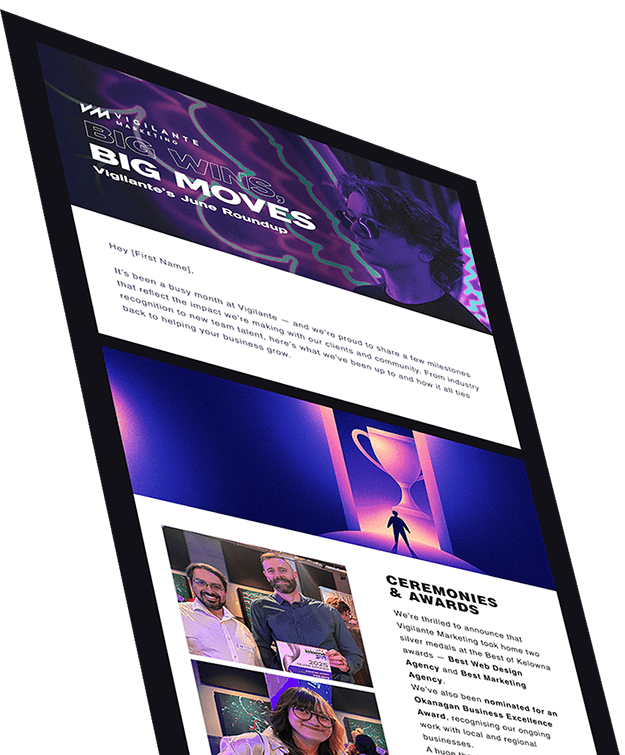
The latest marketing news, promotions, and tips & tricks in our monthly newsletter
"*" indicates required fields