


The Q4 Playbook Just Changed: 4 Shifts to Act On B…
The major platforms rolled out some of their biggest changes of the year right before the busiest selling season. Here’s what changed and what we’d…


There’s a certain type of business decision that feels productive because it looks dramatic.
The full rebrand.
The complete website overhaul.
The “new era” announcement wrapped in polished mockups and cinematic launch videos.
And sometimes, those projects are necessary.
But more often than businesses realise, large redesigns happen because something has quietly been neglected for too long. The business evolved. The brand didn’t. So eventually the gap becomes impossible to ignore.
At that point, companies disappear into months of redesign meetings, endless revision rounds, internal debates about fonts and colours, and a growing sense that everything needs to change all at once.
Meanwhile, marketing slows down. Campaigns stall. Content pauses. Momentum fades.
The irony is that many of these businesses don’t actually have a branding problem. They have an evolution problem.
Most successful brands aren’t built through giant creative resets every few years. They’re built through consistent refinement over time.
A landing page gets improved after conversion data reveals friction points.
An ad creative evolves after audience testing.
Sales material becomes cleaner, sharper, and easier to navigate.
Social content starts feeling more cohesive across platforms.
Packaging gets refined. Messaging gets tighter. The visual system matures alongside the business itself.
Individually, these changes may seem small. But together, they shape how a company is perceived.
And perception matters more than many businesses think.
Customers don’t experience your brand as one grand reveal. They experience it in fragments — a Google search result, an Instagram ad, a website visit, a proposal deck, a product mockup, a LinkedIn post, a packaging detail.
When all those touchpoints feel aligned, current, and intentional, people trust you faster.
Not because they consciously analyse your typography or colour palette. Because the business simply feels more credible, more established, and more confident in what it’s doing.
That feeling matters.

This is where many businesses get stuck.
They assume the issue is purely aesthetic:
“Our brand looks outdated.”
“Our website feels old.”
“Our marketing isn’t converting.”
But often, the deeper issue is that the business has outgrown the system supporting it.
The audience changed.
The positioning evolved.
The offers became more sophisticated.
The company learned what actually resonates in the market.
But the brand infrastructure stayed frozen in time.
Over months or years, this creates what we’d call creative debt — the slow accumulation of outdated visuals, inconsistent messaging, fragmented assets, and disconnected customer experiences.
Eventually, the pressure builds to a point where a massive redesign feels like the only answer.
In reality, many businesses don’t need a complete reinvention. They need a better rhythm of iteration.

A lot of companies still treat branding like construction.
Build it once. Launch it. Leave it alone.
But modern businesses don’t operate in static environments anymore — especially in competitive markets across Canada and North America where customer expectations shift constantly and attention spans get shorter every year.
Your brand can’t afford to stay frozen while your business evolves around it.
That’s why the “One Design a Day” mindset works so well.
Not literally producing endless design for the sake of activity. The point is sustained creative momentum.
One meaningful improvement at a time:
Small refinements create adaptability. And adaptability is one of the most valuable advantages a growing business can have.
Because the market rarely waits for a six-month redesign process to finish.
This is the part businesses consistently underestimate.
Tiny visual improvements compound in the same way operational improvements do.
A slightly stronger landing page improves conversion rates.
Cleaner ad creative increases click-through performance.
More cohesive branding improves recognition and recall.
Sharper presentation design increases perceived credibility during sales conversations.
None of these changes seem revolutionary in isolation. But stacked together over months, they fundamentally change how a business feels in the market.
The strongest brands often don’t look radically different year to year. They just look sharper, clearer, and more aligned every time you encounter them.
That consistency creates trust.
And trust is what moves people toward action.
This matters even more for growing businesses.
When companies scale, things change quickly. New services emerge. Positioning evolves. Customer insights deepen. Marketing channels shift. Competitors adapt.
Rigid branding systems struggle under that pressure.
But brands built around continuous refinement stay responsive. They evolve alongside the business instead of lagging six months behind it.
That’s when design stops being decoration and starts becoming infrastructure — something that actively supports growth instead of slowing it down.
You can already see this shift happening across industries.
SaaS companies now refine websites continuously instead of rebuilding them every few years. Ecommerce brands iterate ad creatives weekly based on live performance data. Beverage and lifestyle brands test seasonal packaging and campaign variations without abandoning their core identity every quarter.
The businesses growing fastest right now are rarely waiting for perfect. They’re refining in real time.
At least not in the way businesses hope they will.
Most customers aren’t emotionally invested in logo reveals or internal brand launches. What they care about is whether your business feels relevant, trustworthy, and clear today.
Does the website feel current?
Does the brand feel cohesive?
Does the messaging make sense?
Does the business feel active and engaged — or neglected and inconsistent?
Those small signals shape perception constantly.
And perception shapes buying decisions long before customers consciously realise it.
The businesses pulling ahead today aren’t necessarily the ones making the loudest changes. Often, they’re the ones refining quietly and consistently in the background.
They treat design as an ongoing business function rather than a one-time event.
Less disruption.
Less creative whiplash.
Less stopping and starting over.
More momentum.
More alignment.
More trust built steadily over time.
Because in modern marketing, momentum almost always outperforms reinvention.

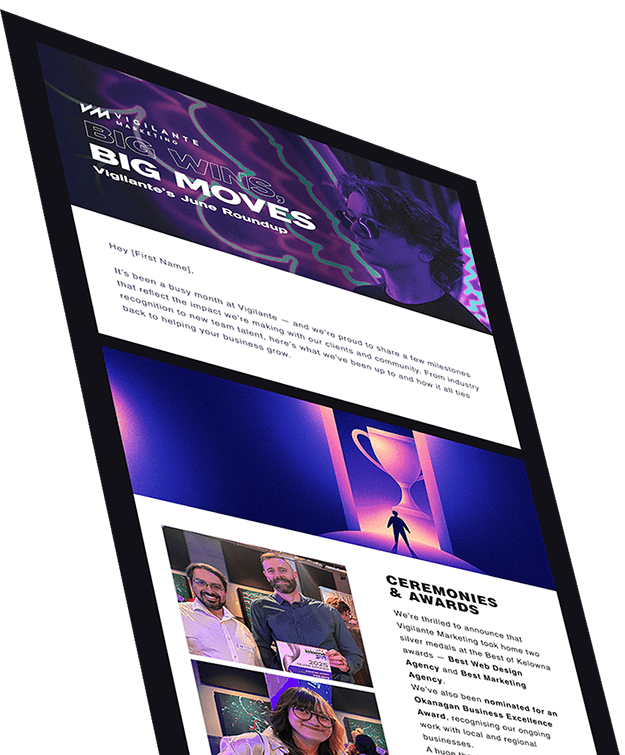
The latest marketing news, promotions, and tips & tricks in our monthly newsletter
"*" indicates required fields