


The Q4 Playbook Just Changed: 4 Shifts to Act On B…
The major platforms rolled out some of their biggest changes of the year right before the busiest selling season. Here’s what changed and what we’d…



Something changed in AI content this month, and most of the coverage got the implications wrong.
On August 2, 2026, transparency rules under Article 50 of the EU AI Act took effect. Companies that build generative AI systems must mark their outputs – audio, images, videos, and text – in a machine-readable format that identifies them as artificially generated, as far as that is technically feasible.
Nine days later, Anthropic confirmed it would embed machine-readable watermarks into text generated by new Claude models, and would apply that marking everywhere Claude is available rather than only in Europe. Around 190 organisations signed the EU’s voluntary Code of Practice on Transparency of AI-generated Content by the end of July 2026, 82 as providers, 152 as deployers – including Google, Microsoft, OpenAI, Anthropic, Mistral and Meta.
The reaction online was immediate and mostly panicked. Content teams started asking whether their pages were about to be flagged, demoted, or de-indexed.
The short answer is no. The longer answer is more useful.

Forget hidden characters or metadata tags. Those get stripped the moment text is copied into a new document.
A text watermark works differently. When an AI model writes, it selects one word at a time, and at most points there are several equally good options available. A watermark uses a secret key to nudge those choices into a specific statistical pattern, one that a reader cannot perceive but that a detector holding the key can measure across a long enough passage.
The method Anthropic adopted, SynthID-Text, doesn’t change how the model was trained. It only alters the sampling process, and detection runs without needing access to the model itself. The text isn’t what the model would otherwise have written, but no reader can tell the difference.
Because the pattern lives in the word choices themselves, it travels with the text when copied and pasted, and can survive some editing.

No, and the strongest evidence is Google’s own behaviour.
Google has been watermarking Gemini’s text output since 2024 and has never indicated it uses that signal in ranking. The AI-detection features it added to Search and Chrome cover images, video, and audio, and are presented as provenance checks for users rather than ranking inputs.
Google’s underlying principle hasn’t changed since February 2023: it evaluates whether content is useful, original, and trustworthy, not which tool produced it. What it penalises is content mass-produced primarily to manipulate rankings.
That last part is what deserves your attention. Two developments matter far more than watermarking:
On May 15, 2026, Google clarified that its spam policies cover attempts to manipulate generative AI responses, AI Overviews and AI Mode included. A documentation change rather than a new rule: Google’s position is that the existing policies always applied here.
The August 2026 spam update began rolling out on August 18, globally, across every language.
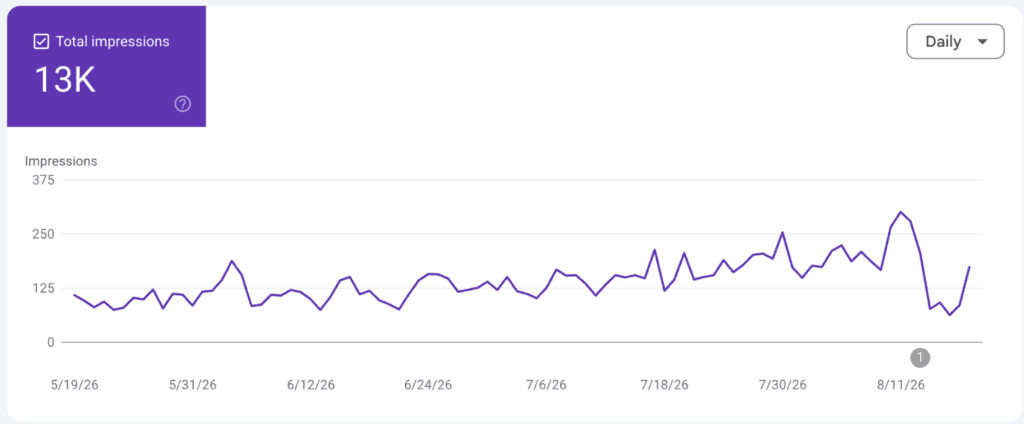
If your AI overview impressions moved in the last week, the August 2026 spam update is the first place to look.

Almost no direct impact, because platform labelling rules are built around visual and audio media rather than text.
YouTube is the clearest example. It requires disclosure for realistic synthetic content, but its exemption list names scripts, titles, captions and idea generation outright, no label needed. TikTok’s requirement likewise applies only to AI-generated visuals and audio depicting realistic people or scenes. Meta applies an “AI info” label to AI-generated images, video and audio content across Facebook, Instagram and Threads.
One structural note worth filing away: platform detection relies on C2PA metadata, which C2PA itself concedes is routinely stripped during upload and transcoding, which is why TikTok began adding its own invisible watermarks in late 2025. Text watermarks survive stripping in a way metadata does not. No platform has announced using them. But the capability now exists where it didn’t before.
Here is the part most coverage skipped: this is European legislation, and Canada has no equivalent.
Canada’s Artificial Intelligence and Data Act, introduced as part of Bill C-27, died when Parliament was prorogued in January 2025 and has not been revived. The federal government chose privacy legislation and targeted policy instead. In June 2026 it launched “AI for All”, a five year national AI strategy, and tabled two bills still at second reading: C-36, which would replace PIPEDA’s privacy rules, and C-34, which would require platforms to label synthetically generated content. Neither is an AI act. Otherwise regulators rely on existing privacy, consumer protection, and competition law, plus the Voluntary Code of Conduct for Generative AI, which binds AI developers, not the businesses using their tools.
So no Canadian law requires you to label AI-assisted marketing copy today. That said, three things are worth understanding.
Article 2 of the AI Act applies to providers and deployers established outside the EU where the output produced by an AI system is used within the EU. No EU office required, no EU marketing required. How far that actually reaches is untested; there’s no case law yet. For a Kelowna winery selling to Okanagan visitors, it almost never fires. For a Canadian exporter with European distributors, or a SaaS company with EU customers, it may already have.
Anthropic applied text watermarking worldwide, not because Canada asked for it, but because scoping the feature by region was not straightforward. This is the pattern to watch. Canadian businesses will feel European AI regulation primarily through the tools they use, not through Canadian statutes. You get the compliance behaviour whether or not the law applies to you.
Google Ads surfaces AI disclosures through My Ad Center globally, and adds visible overlays in the EU, India, and New York for assets an advertiser designates as AI-created or AI-edited. Canada is not on that overlay list today. The global disclosure layer still applies to your account.
The takeaway for Canadian marketers is not urgency. It’s that the standards being set in Brussels are arriving in your toolset regardless, and that a documented internal policy is cheaper to build now than to retrofit when Canadian legislation eventually lands.
We use AI. We would rather say so plainly than pretend otherwise while every agency in the country quietly does the same.
What we don’t do is publish it unedited.
AI is genuinely good at research synthesis, first drafts, and volume tasks that would otherwise consume hours. It is not good at knowing your brand, your customers, your market, your margins, or the thing a competitor did last spring that still shapes how people talk about your category. It produces confident sentences about things it cannot verify.
So the work that matters stays with people: strategy, positioning, judgment about what is actually true, and a final read before anything ships with a client’s name on it. A watermark on a draft is irrelevant once a human has rewritten it, checked the facts, and shaped it into something that reflects a real business.
That was already our standard. This month’s news didn’t change it. It just made the reasoning easier to explain.
Invisible watermarks in AI text are real, they are now widespread, and they are not a search penalty. Canada has no law requiring you to label AI-assisted content, though the European rules will keep shaping the tools you use. The risk to your visibility was never the technology. It was publishing generic, unverified content at volume and hoping nobody noticed.



The latest marketing news, promotions, and tips & tricks in our monthly newsletter
"*" indicates required fields