GA4 Explained: What Businesses Still Get Wrong in…
Google Analytics 4 (GA4) has been the default analytics platform for more than a year now, yet many businesses are still struggling to trust their…



Artificial intelligence is no longer something only enterprise brands can access.
Today, businesses of all sizes are using AI to improve campaign performance, work more efficiently, personalise customer experiences, and make better marketing decisions. What once required large teams and manual analysis can now be done faster and more accurately with the right tools and workflows.
That said, using AI well is not about replacing marketers. It is about giving marketers better data, sharper insights, and more time to focus on strategy, messaging, and creative thinking.
In this guide, we’ll break down what AI marketing is, how it works, where it creates value, the challenges to watch for, and how to start implementing it in a practical way.
AI marketing is the use of artificial intelligence tools and systems to support, improve, and automate marketing activities.
These tools can help businesses analyse customer data, predict behaviour, personalise content, optimise campaigns, and automate repetitive tasks. Instead of relying only on manual guesswork, marketers can use AI to identify patterns, uncover opportunities, and make decisions with more confidence.
Think of AI marketing as an extra layer of intelligence inside your marketing engine. It helps you understand what your audience is doing, what they are likely to do next, and what actions are most likely to improve results.
Common examples of AI in marketing include:

Used correctly, AI can help businesses improve efficiency, reduce wasted spend, and create more relevant experiences across the customer journey.
Marketing has become more complex.
Customers move across multiple channels before they take action. They discover brands through social media, compare options through Google, read reviews, open emails, click ads, and sometimes ask AI tools for recommendations before they ever fill out a form.
That creates a huge amount of data and a lot of decision points. AI helps marketers manage that complexity.
Instead of manually reviewing hundreds of data points, AI can quickly identify patterns such as:
There are many ways to apply AI in marketing, but some use cases are much more practical and valuable than others.
AI can make email marketing much more effective by helping you send the right message to the right person at the right time.
Rather than sending the same email to your entire list, AI tools can segment audiences based on interests, activity, behaviour, and stage in the buying journey. Some tools can also suggest subject lines, generate copy variations, and recommend the best send times.
AI can help with:
For example, a business could send different email sequences to first-time leads, returning website visitors, and existing customers. Each group receives messaging more relevant to where they are in the journey.
This leads to stronger engagement and better conversion rates.
AI can speed up content production significantly when used properly.
It can help generate outlines, first drafts, content ideas, headline options, FAQs, ad copy, email variations, and repurposed content. It can also help marketers overcome blank-page syndrome and move from idea to execution faster.
That said, AI should not replace strategy, brand judgment, or editing. The strongest use of AI in content creation is as an assistant, not the final author.
AI can help marketers:
For example, a marketing team could take one webinar transcript and use AI to turn it into a blog outline, LinkedIn post, email summary, and ad copy variations.
This reduces production time while helping teams get more value from each asset.
AI chatbots help businesses respond to enquiries instantly, even outside business hours.
They can answer basic questions, qualify leads, direct users to the right page, and capture contact information. More advanced tools can support booking, troubleshooting, and handoffs to a human team member when needed.
Common chatbot uses include:
For example, a visitor on a services page might ask about pricing, timelines, or availability. A chatbot can answer quickly and guide the person toward the next step instead of waiting for a form reply the next day.
This improves responsiveness and reduces friction in the customer journey.
Paid advertising generates a huge amount of performance data, and AI is especially useful here.
AI can evaluate which audiences, placements, creatives, and bidding strategies are working best, then shift spend toward the combinations most likely to produce results. Many ad platforms already use machine learning under the hood, but marketers can strengthen outcomes further by feeding better creative, cleaner data, and stronger conversion signals into the system.
AI helps by:
For example, a campaign might reveal that a specific message resonates far better with one customer segment than another. AI can detect that pattern early and help push the stronger version more aggressively.
The biggest benefit is efficiency. Less wasted ad spend and stronger ROI.
AI also plays a major role in search marketing.
It can help identify content gaps, group keywords by intent, analyse competitors, suggest heading structures, improve readability, and surface optimisation opportunities across existing pages.
Some platforms go even further by scoring content based on relevance and helping marketers align pages with what searchers are actually looking for.
AI can support SEO by:
For example, if users frequently search for a service plus “cost,” “near me,” or “how it works,” AI tools can surface those themes so content better matches what people want to know.
This is especially useful for businesses trying to create helpful, search-friendly content at scale.
Sentiment analysis uses AI to examine reviews, comments, feedback, and social media mentions to understand how people feel about your business or brand.
It helps marketers identify patterns in customer perception, uncover issues early, and monitor shifts in reputation over time.
AI can review language and identify whether feedback trends positive, negative, or neutral. It can also surface recurring themes that might otherwise be missed.
This is useful for:
For example, if reviews repeatedly mention slow response times, confusing onboarding, or excellent customer service, those insights can directly shape messaging and operational improvements.
One of the most useful applications of AI is identifying which leads are most likely to become customers.
AI-powered lead scoring looks at behavioural data, engagement history, demographics, and past conversions to rank leads based on their likelihood to convert. This helps sales and marketing teams focus their time on the best opportunities instead of chasing every lead equally.
Here’s how it usually works:
For example, if someone visits your pricing page multiple times, downloads a guide, and opens several emails, AI can recognise that pattern as stronger intent than someone who only viewed one blog post.
The benefit is simple: your team spends more time on the leads that matter.
Testing is one of the most important parts of marketing, and AI can help speed it up.
Rather than waiting for long testing cycles, AI can help identify winning headlines, calls to action, landing page layouts, offers, and creative variations faster. Some tools can automatically allocate more traffic to stronger-performing versions as the results come in.
AI supports testing by:
This helps marketers make more informed decisions and continuously improve campaign performance.

AI has major upside, but it also comes with risks and limitations. Businesses need to be aware of these before they rush in.
AI often relies on customer data, and that means privacy matters.
If your systems collect personal information, behavioural data, or purchase history, you need to ensure that information is stored, processed, and used responsibly. Regulations such as GDPR and other privacy standards make this even more important.
How to reduce the risk:
AI is only as good as the data behind it.
If your CRM is messy, your tagging is inconsistent, or your campaign tracking is incomplete, the outputs will be unreliable. Bad inputs lead to bad recommendations.
How to improve it:
Many teams want to use AI but do not know where to begin.
Some struggle with choosing the right tools. Others rely too heavily on AI outputs without enough human oversight. Without the right understanding, businesses can end up wasting money on tools that never get used well.
How to improve it:
Not every AI solution is affordable, especially for smaller businesses.
Some tools come with setup costs, integration complexity, and ongoing subscription fees. Businesses should be careful not to overinvest before proving value.
A better approach:
One of the biggest mistakes businesses make is leaning too hard on AI-generated content and automation. The result can feel generic, robotic, or disconnected from the audience.
AI is powerful, but trust is still built by people.
The best approach is to let AI handle analysis and efficiency while humans guide strategy, empathy, messaging, and relationship-building.
AI tools are only useful if they fit into your existing systems.
If your website, CRM, ad platforms, email software, and reporting tools are disconnected, it becomes much harder to get clear insights or run smooth workflows.
How to improve it:

If you want to start using AI without creating chaos, follow a structured process.
Start with the business problem, not the tool.
Ask:
Clear goals make it easier to choose the right solution.
Look at what data you already have and where it lives.
Review:
The goal is to understand what is usable, what is missing, and what needs cleaning up before AI can be effective.
Do not try to do everything at once.
Pick one use case with strong upside and relatively low complexity. For many businesses, that could be:
Choose the one most likely to create measurable value quickly.
Run a focused test before rolling AI into your entire marketing operation.
For example:
Keep the scope tight and define success clearly.
AI tools are only as useful as the people using them.
Make sure your team understands:
Confidence and clarity matter more than complexity.
Once the pilot performs well, expand carefully.
Bring AI into existing workflows where it supports performance and saves time, but avoid forcing it into areas where it adds more confusion than value.
Good integration is usually gradual, not instant.
AI is not a set-and-forget solution.
Track results, review outputs, and make adjustments. Watch for patterns, weak points, and opportunities to improve the workflow.
Measure:
Customers still care about authenticity, privacy, and transparency.
Be careful with over-automation. Make sure your brand still sounds like your brand. Protect customer trust. Use AI to improve the experience, not make it feel colder.
There is no shortage of AI tools on the market, but a few categories are especially practical for growing businesses.
These help with blog outlines, ad copy, email drafts, content repurposing, and idea generation.
Examples include:
These tools are best used for first drafts, ideation, and production support.
These help marketers improve search visibility and align content with what people are searching for.
Examples include:
These tools help with structure, keyword relevance, and content improvement.
These support segmentation, subject lines, send-time optimisation, and behaviour-based automation.
Examples include:
These tools help businesses send more relevant emails with less manual work.
These support audience targeting, creative optimisation, campaign analysis, and budget efficiency.
Examples vary depending on platform, but many ad systems now include AI-driven features for bidding, creative combinations, and predictive performance.
These help businesses automate common conversations and capture leads more efficiently.
Examples include:
These are useful when response speed and lead qualification matter.
The value of AI becomes clearer when you picture it in action.
A local HVAC company uses AI to:
The result is faster lead handling and more efficient ad spend.
An online retailer uses AI to:
This improves both revenue and customer experience.
A marketing agency or software company uses AI to:
This helps shorten production time while improving marketing precision.
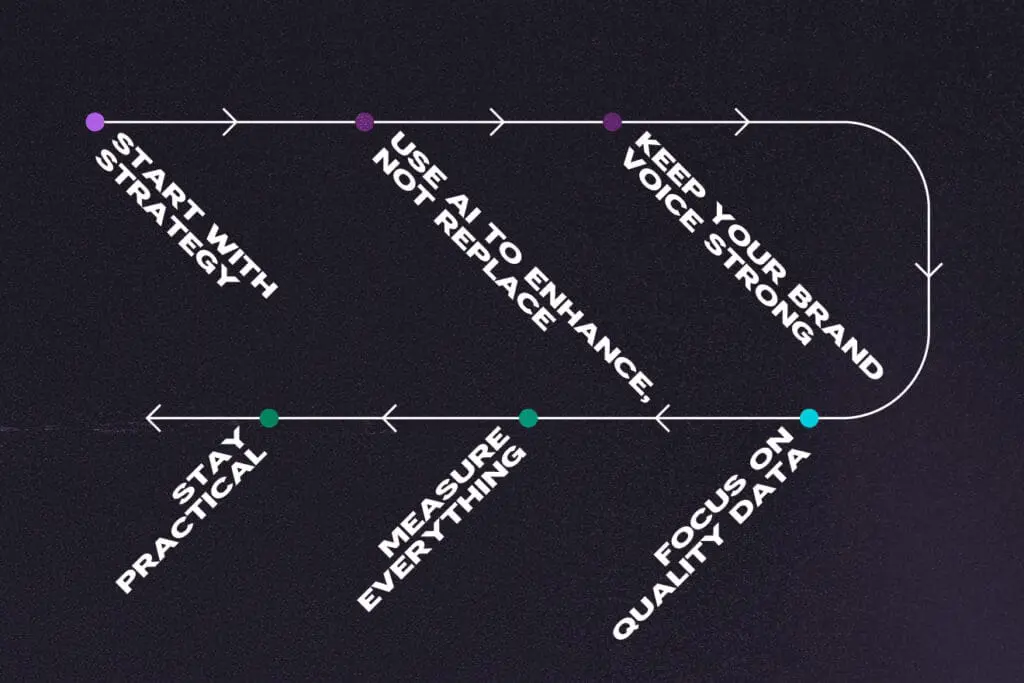
To get the most value from AI, keep these principles in mind:
Do not use AI just because it is available. Use it where it supports a real business goal.
The best results happen when AI supports marketers, not when businesses try to hand everything over to automation.
Edit all AI-generated content carefully. The output should still sound human and feel aligned with your brand.
Good decisions depend on good inputs.
Track impact clearly so you know what is worth scaling.
Not every tool is necessary. Choose tools that solve real problems and fit your workflows.
AI is changing marketing, but the goal has not changed.
Businesses still need to reach the right people, earn trust, communicate clearly, and drive action.
What AI changes is the speed, scale, and accuracy with which marketers can do that.
Used well, AI can help you create better campaigns, improve customer experiences, save time, and make smarter decisions. Used poorly, it can create noise, bland content, and confusion.
The key is balance.
Use AI where it creates efficiency and insight. Keep humans at the centre where judgment, strategy, empathy, and brand experience matter most.
That is where the strongest results happen.
At Vigilante Marketing, we see AI as a tool, not a shortcut.
We help businesses use it in ways that actually support growth, whether that means improving campaign performance, streamlining content workflows, refining targeting, or creating better conversion paths through our individual marketing services or All-Inclusive Marketing Retainer.
That includes:
The goal is not to use more tools. The goal is to build a marketing system that works harder and smarter.