How to Use AI in Marketing: Strategies, Use Cases,…
OverviewArtificial intelligence is no longer something only enterprise brands can access. Today, businesses of all sizes are using AI to improve campaign performance, work more…
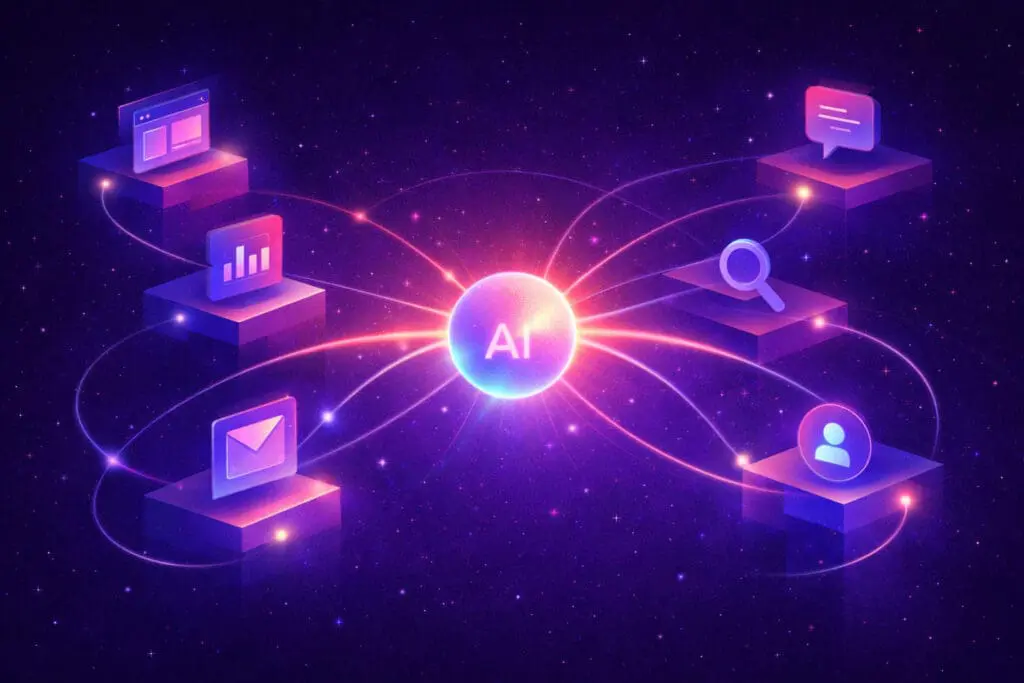



Artificial Intelligence is now embedded in nearly every business and marketing conversation. From content creation to forecasting revenue, AI promises speed, efficiency, and smarter decisions. Yet many organizations struggle to separate genuine value from hype.
The reality is simple. Not all AI is the same, and not every type of AI is useful for every business. Understanding how different AI systems work helps leaders invest wisely, set realistic expectations, and avoid costly missteps.

Most AI tools used in business today fall into the category of Narrow AI.
Narrow AI is designed to perform specific tasks extremely well, but only within defined boundaries. These systems do not think independently or adapt beyond their programming and training data.
Common business applications of Narrow AI include:
General AI refers to systems that can reason, learn, and think across domains like a human. While it is often discussed in media and future predictions, it does not exist in practical business environments today.
For businesses, this distinction matters. Expecting Narrow AI tools to think strategically or replace leadership decisions leads to frustration and poor outcomes.

Predictive AI and Generative AI are often grouped together, but they serve very different roles inside organizations.
Predictive AI focuses on analyzing historical and real time data to forecast outcomes. It helps businesses anticipate what is likely to happen next.
Predictive AI commonly powers:
Generative AI, by contrast, creates new outputs based on patterns it has learned. It is most visible in tools that generate content and creative assets.
Generative AI is commonly used for:
Businesses see the strongest results when generative AI supports creativity and speed, while predictive AI supports planning and decision making.

Another important distinction is between AI that executes tasks and AI that supports judgment.
Automation AI focuses on efficiency. It handles repetitive, rules based tasks that would otherwise consume human time.
Typical automation use cases include:
Decision AI supports strategic thinking by identifying insights and patterns humans may overlook. Rather than acting on its own, it informs better choices.
Decision AI helps with:
This is where AI delivers its highest value, not by replacing people, but by improving the quality of human decisions.
The most common mistake businesses make is expecting AI to replace strategy rather than support it.
AI can:
AI cannot:
When AI is deployed without clear objectives, clean data, and human oversight, it often produces noise instead of insight.
AI is not a shortcut to success. It is a powerful tool that amplifies whatever strategy already exists.
Businesses that win with AI are not the ones using the most tools or chasing the latest trends. They are the ones that understand which type of AI they need, where it adds value, and where human expertise remains essential.
The future belongs to organizations that combine intelligent technology with thoughtful leadership, using AI wisely rather than blindly.